
Customer Acquisition Channels: What They Are and Which Ones Exist
An old salesman kept a map in his garage with pins in ten colors. Each color was a path a customer took to reach him. What he knew, almost nobody applies.

Luiz Philipe (LP)
Updated October 24, 2026

The map hung at the back of the garage, behind a bicycle nobody had ridden in years. A map of the state, yellowed, held up with masking tape at all four corners. And stuck into it, hundreds of pins with colored heads.
Jenna had come to borrow a ladder. She left with a question that would change the way she looked at her own business.
"Uncle Walt, what is that?"
Walt sold hardware to small-town stores for thirty-one years. He retired with the house paid off, two kids through college and a reputation that still made store owners call him at Christmas. He looked at the map the way you look at an old photograph.
"Every pin is a customer I won. The color tells me how he got to me."
Red was a referral from another store owner. Blue, a trade show. Yellow, the phone. Green, the paint rep who shared his car and passed along names. White, the chamber of commerce directory. Ten colors in all.
"Why sort them by color?"
"Because the fellow who started with me, same year, same company, only had one."
Jenna didn't answer. She was thinking about her phone, where every new client at her Pilates studio for the last two years had come from the same place: Instagram. And she was thinking about March, when post reach dropped by half and her schedule opened up gaps she still hadn't managed to fill.
What are customer acquisition channels?
A customer acquisition channel is any repeatable path through which someone who didn't know your business gets to know it and becomes a customer. Referrals, Google search, ads, partnerships with other businesses, trade shows, cold calls and a storefront window are all channels. What separates a channel from a one-off action is repetition: you can do it again, measure what it costs and know how many customers it brings in each month.Every business has at least one channel, even if it never gave it a name. The risk isn't having few customers. It's depending on a single path to get all of them.
CAC, or customer acquisition cost, is what you spend on a channel (in money and in hours) divided by the number of customers it brought in. Predictability is knowing that a certain number of actions, or a certain investment, in that channel usually brings in a new customer. Anyone who has both numbers can plan the month. Anyone who doesn't just waits.The fellow with one color
Walt's colleague was a better salesman than he was. Friendlier, quicker at closing an order. But his map, if he'd had one, would have shown one enormous pin: a chain of building supply stores that bought half of everything he sold.
Then the chain was sold. The new owner showed up with his own suppliers, and that half vanished in a single month. The colleague spent the rest of his career trying to rebuild what he lost in thirty days.
That same year, Walt also lost a big account. It hurt. But it was one pin among hundreds, spread across ten colors. Nobody at home even noticed.
The guide that inspired this article sums up the difference in one sentence: "A business that depends on one channel lives in feast or famine. A business with three channels working has predictability."
What are the main acquisition channels? The 10 families
There are dozens of channels, but they all fit into ten families. Knowing the ten is what lets you look at your own business and ask: which of these have I never gotten a customer from?
1. Referrals and word of mouth. The cheapest customer is the one a happy customer brings you. This includes referral programs where both the referrer and the new customer get something (Dropbox grew by giving extra storage to both sides), asking for referrals at the right moment, Google reviews, customer stories, ambassadors and loyalty programs. First step: find the moment when your customer is happiest and ask for the referral exactly there, every time.
2. Partnerships. Other businesses already have the customers you want. This includes cross-referrals with complementary businesses, joint marketing, bundles with partners, affiliates, resellers and distributors, white label, franchising and licensing. First step: list five businesses that serve your customer right before or right after you do, and propose a swap to one of them.
3. Content and search. Being found when people are already looking. This includes a blog built around search intent (SEO), your Google Business Profile, being cited by AI assistants (known as GEO), pages by city or service, free tools and calculators, ready-made templates, a newsletter, lead magnets and articles on other people's sites. First step: write down the ten questions every customer asks before buying and answer each one in writing, in public.
4. Social media and video. Attention is where your customer scrolls every day. This includes short videos, a YouTube channel, Instagram as a storefront, LinkedIn, Pinterest, content created by your own customers, influencers and creators, and live-streamed selling. First step: choose one format, with a fixed schedule and a clear invitation to the next step at the end of every post.
5. Paid ads. Buying attention with control. This includes search ads, social media ads, remarketing (showing your ad again to people who already visited), Google shopping ads, ads inside marketplaces, YouTube, native ads, display and sponsorships of podcasts and newsletters. First step: start small, with one audience, and measure all the way to the sale, not the click.
6. Outbound prospecting and direct sales. Going after the customer instead of waiting. This includes cold email, LinkedIn prospecting, phone calls, messaging, SMS, direct mail, field and door-to-door sales, direct selling networks, account-based marketing (picking specific companies and building an approach for each one) and selling to the government through public procurement. First step: build a list of thirty ideal customers and write a researched approach for each.
7. Communities and events. People buy from those they know and trust. This includes your own community, taking part in groups that already exist, forums, Q&A sites, online classes, in-person workshops, trade shows, talks and associations or chambers of commerce. First step: join a group where your customer already talks and spend a month helping before you offer anything.
8. Platforms and marketplaces. Selling where demand already exists. This includes product and service marketplaces, app stores, review and comparison sites, directories, deal and coupon sites, launch platforms, crowdfunding and waitlists with referrals. First step: list one product or service on a platform where your customer already searches and watch what happens over thirty days.
9. Offline and local. The street is still a channel. This includes window displays and signage, free samples, try-at-home offers, pop-up shops and booths, flyers, outdoor advertising, local radio and TV, vehicle decals, local sponsorships and package inserts with a QR code. First step: make one printed piece with a QR code that exists only on it, so you know exactly how many customers it brought in.
10. PR, creativity and product. Doing something worth talking about. This includes press relations, guesting on other people's podcasts, running your own podcast, writing a book, creating a course, offering a free trial, running contests and challenges, creative stunts, cause marketing and custom products. First step: list ten podcasts or journalists who talk to your customer and prepare a pitch that interests their audience, not you.
No business needs all ten at the same time. But almost every business that stalls is using one or two and has never looked at the other eight.
How many acquisition channels should a business have?
The target is three channels working, with known numbers. One alone is feast or famine. Ten at once is scattered: none gets enough attention to show whether it works.
The path is gradual, and the guide fits in one sentence here too: "Start with one. Measure for 30 days. Then add the next." If you want to go deeper on the choice, this piece shows how to choose the right marketing channel for your business.
The 4 rules for choosing your first channels
Before testing any channel, four questions save you months:
Intent: does the channel bring the customer you want, or just views? A thousand likes from people who will never buy are worth less than three conversations with someone who needs you.
Predictability: can you tell, after a while, that this many actions or this much investment brings in a customer? If you can't measure it, you can't grow it.
Fit: is your customer already there? A great channel for a different audience is a bad channel for you.
Routine: can you keep up the test consistently for 30 days? A channel abandoned in week two wasn't tested. It was attempted.
The night Jenna drew her own map
Jenna went home without the ladder.
That night she took a sheet of paper, wrote the ten families in a column and put an X next to the ones that had already brought in a client. She marked one. Then, being generous, a second: two clients had come through referrals, by accident, without her asking.
Next to each empty family, she tried to jot down an idea. Partnerships: physical therapists and orthopedists in the area, who treat people who need to rebuild their strength after treatment. Search: the studio's Google profile, which had three crooked photos and not a single review. Communities: the running group that trained in the park at six in the morning, two blocks away.
But she got stuck halfway. She didn't know where to start with each one, what it cost to test, or which to pick first.
Walt took thirty-one years to discover his ten colors, by trial and error, road after road. You don't need that kind of time.
The 100 channels, all in one place
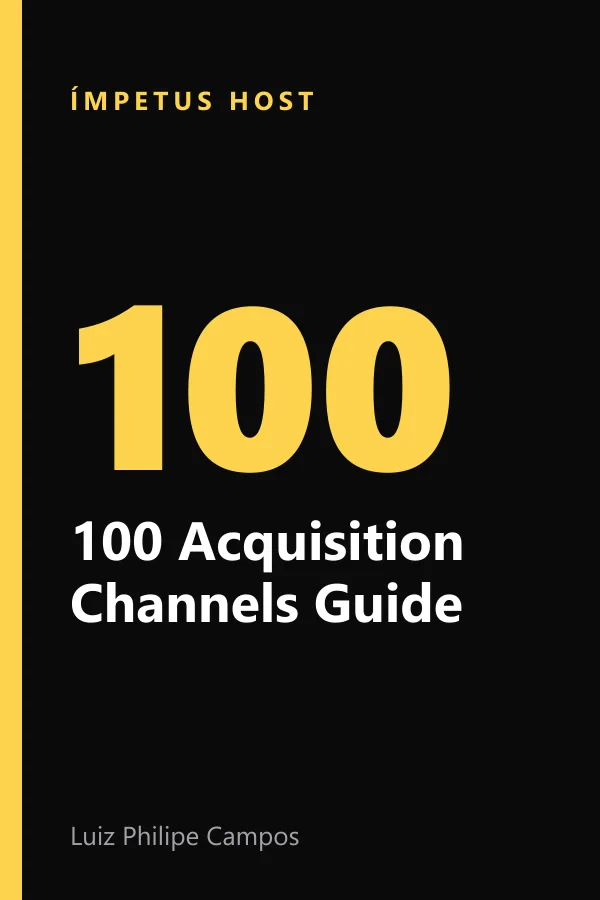
The 100 Acquisition Channels Guide is exactly Walt's wall, organized. It holds 100 channels divided into the same 10 families in this article. For each channel, you get what it is, a practical example, the first step to test it, who it works best for and what it costs to test: free, low, medium or high.It also includes two bonuses that solve exactly where Jenna got stuck: a scoring worksheet to rate each channel by cost, speed and fit and choose your first three, and a 30-day test plan, day by day, to launch your first new channel, measure it and decide whether to keep it, adjust it or swap it.
Next step
Don't depend on a single way to win customers
Everything in this article works better when new customers arrive every month. Most businesses depend on two or three channels and suffer when one of them slows down. The 100 Acquisition Channels Guide shows 100 ways to win customers, a practical example of each one and the first step to test it spending little or nothing.
- ✓The 100 channels, one by one, from the best known to the ones almost nobody uses
- ✓A practical example and a low-cost first step for each channel
- ✓A simple way to choose the channels that fit your business now
- ✓Bonus: Channel scorecard
- ✓Bonus: 30-day test plan
One-time payment · Instant access · 7-day guarantee
Access is immediate: the PDF arrives in your inbox and you can read it on your phone, your computer or in print. It costs less than a day of ads, it's a one-time payment and it comes with a 7-day guarantee through Hotmart. If it's not for you, you ask for your money back.
And nobody has to test 100 channels. You need one good new channel at a time. Walt's map started with a single pin.
Walt and Jenna are characters created for this text.Frequently asked questions
What are customer acquisition channels?+
Acquisition channels are the repeatable paths through which people who didn't know your business get to know it and become customers, such as referrals, Google search, ads, partnerships, trade shows and outbound prospecting. A channel differs from a one-off action because it can be repeated and measured. The ideal is to know how many customers each channel brings in and what each one costs.
What are the main types of acquisition channels?+
Channels fall into ten families: referrals and word of mouth, partnerships, content and search, social media and video, paid ads, outbound prospecting and direct sales, communities and events, platforms and marketplaces, offline and local, and PR, creativity and product. Each family includes several specific channels. Most small businesses use only one or two.
How many acquisition channels should a small business have?+
The target is three channels working, with known numbers for cost and results. Relying on just one leaves the business exposed to any change in that channel. The safest path is to start with one new channel, measure it for 30 days and only then add the next.
What is the difference between an acquisition channel and a sales channel?+
An acquisition channel is how the customer discovers the business; a sales channel is where they actually buy. Someone can learn about a store through a video and buy at the counter. Separating the two helps you notice when a business depends on a single path to be found.
Where can I find a complete list of acquisition channels with the first step for each?+
The 100 Acquisition Channels Guide, by Luiz Philipe Campos, brings together 100 channels in 10 parts, each with an explanation, an example, a first step, the ideal audience and the cost to test. It includes a worksheet to choose your first three channels and a 30-day test plan. Access is immediate through Hotmart, with a 7-day guarantee.
Does it work for my type of business?+
Yes. The channels cover local businesses, service providers, online stores, B2B companies and professionals. The guide helps you pick the ones that fit your case.
How do I receive the guide?+
Right after payment, Hotmart sends the access to your email. You can read it on your phone, computer or print it.
What if I don't like it?+
You have a 7-day guarantee. If it isn't for you, ask for a refund through Hotmart within that period.
The 100 Acquisition Channels Guide
100 ways to win customers without depending on a single source of sales
Get the 100 acquisition channels guide for $49One-time payment · Instant access · 7-day guarantee