
How to Get Clients for a Service Business
At 7:40 a. m. , an architect in the middle of a renovation needed an electrician yesterday. She had two numbers saved. She called the less talented of the two. And she was right.

Luiz Philipe (LP)
Updated October 24, 2026

The apartment's electrical panel had been wired by someone who clearly never expected to be seen again. Unlabeled wires, a melted breaker in the corner and a splice that Tara preferred not to touch.
The client was due at ten to see the finished kitchen. The kitchen would not be finished without power.
Tara opened the contacts on her phone. Two electricians.
The first was Ed. Technically the best she had ever seen work. Organized, meticulous, the kind of pro who leaves a panel so neat you want to photograph it.
The second was Leo. Good. Really good. But not as good as Ed.
She called Leo.
To understand why, you have to go back two years.
The short answer: service providers sell trust, and trust arrives through channels
To get clients in a service business, the strongest path is to be on the list of whoever already serves your client before or after you (complementary partnerships), be well reviewed where clients look (Google and service platforms) and turn every service delivered into a referral asked for at the right moment. A provider who depends on a single contractor or on spontaneous word of mouth lives with a packed calendar one month and an empty one the next.
Ed's year
Two years ago, Ed had an enviable calendar. Almost all his work came from a small local builder who ran three or four projects at once. The site foreman liked him, paid on time and called every Monday.
Ed didn't need anyone else. And so he never looked for anyone else.
He had no Google profile. He didn't ask for reviews. When an end client asked whether they could pass his number to a friend, he said yes but warned them he was pretty busy.
Until the builder stopped launching projects. And Ed's calendar, which lived on a single channel, went empty from one week to the next.
By the time Tara met him, he was accepting any job, on any deadline. He was excellent. And he was always either unavailable or desperate, never anywhere in between.
Leo's year, in five phone calls
Leo's year was less dramatic. You can tell it in five phone calls.
1. The call he made. In January, Leo sat down on a rainy afternoon and made a list: who serves the same client I do, before or after me? Architects, interior designers, cabinetmakers, drywall finishers, HVAC installers, property managers. He called an architect and made a simple proposal: when a client of mine mentions a remodel, I'll pass along your name; when a client of yours needs electrical work, you pass along mine. That's how he met Tara.
2. The call he didn't miss. Leo set up his Google profile with his neighborhood, his services and photos of before-and-after panels. In March, a woman who had just moved in typed electrician near me at nine at night, with half the house without power. He showed up, with reviews. Ed showed up nowhere.
3. The call that came from the property manager. Leo did a job in a common area of a condo building and, when he finished, left the manager a simple one-page report: what he found, what he fixed, what would need attention in six months. The manager forwarded the report in the regional property managers' group. Three condo buildings called.
4. The call he asked for. At the end of every job, when the client flipped on the light that hadn't worked before and said wow, what a difference, Leo asked right there, in that instant, for a review and the name of someone who was remodeling. At the moment the client felt the result.
5. The 7:40 call. In October of the second year, Tara called. She knew Leo would pick up, because he never depended on a single job to exist, and so he had an organized calendar and not a hostage one.
Leo wasn't the best electrician on the list. He was the most findable, the most referred and the most predictable. In the service market, that usually counts for more.
Why a good service provider ends up without clients
Ed's story repeats in every profession. The person is good at what they do, and so they believe quality will bring clients on its own.
Quality keeps the client. Channels bring the client.
When all the work comes from one contractor, one platform or spontaneous word of mouth, the provider has a single channel and doesn't control it. All it takes is for the contractor to stop, the platform to change its rules or the referrers to move to another city, and the calendar empties.
The channels that work best for service providers
These are the channels Leo used, plus a few that work well for almost any provider, with the first step for each:
Complementary partnerships. First step: map the "before and after" of your service (who the client hires before calling you and after you) and propose a referral swap where both sides win. To go deeper, read business partnerships: how to sell more using another business's customers.
Google Business Profile. First step: list your services and the area you cover, post real photos of jobs and respond to every review.
Reviews asked for at the right moment. First step: identify the instant the client notices the result and make that instant your fixed moment to ask.
Client stories. First step: document the before and after of three jobs, with the client's permission, and use them on your profile, in your quotes and in conversations with partners.
A deliverable that travels. Like Leo's one-page report: something the client feels like forwarding. First step: create a simple summary of the work done to hand over at the end of every job.
Service platforms. First step: open a profile on a platform where clients in your area request quotes and treat it as one channel among several, never as the only one.
Associations and professional groups. First step: attend a meeting of an association or a group where your natural partners are, such as property managers, architects or real estate agents.
The point isn't to do all seven. It's to go from one to three, one at a time, measuring where each client comes from.
9:55 a.m.
When Tara's client arrived, the kitchen light was on. On the counter, next to the floor plan, sat a sheet listing what had been fixed in the panel.
The client read it, put it in her purse and asked whether she could pass the electrician's contact to her sister.
Ed was a better electrician than Leo. That was never the problem. The problem is that when the work stopped, nobody else knew where to find him.
Which list are you on?
Do Tara's exercise in reverse. Think of who could refer you today: an architect, an accountant, a property manager, a doctor, a real estate agent. Are you saved in their phones? If they needed someone like you at 7:40 a.m., would they call you or the competitor they find more easily?
If the answer makes you uncomfortable, the problem isn't your service. It's the number of paths that lead to it.
Leo built his by trial and error, over a year. There's a shortcut: knowing the possible channels in advance, knowing the first step for each and choosing three that make sense for your profession.
The 100 Acquisition Channels Guide has exactly that. It covers 100 channels in 10 parts, among them referrals, partnerships, local search, service platforms, associations, events and prospecting. For each channel, you read what it is, a practical example, the first step to test it, who it works best for and the cost to test. And you get two bonuses: the worksheet to score channels by cost, speed and fit and choose your first three, and the 30-day plan, day by day, to test your first new channel and decide whether to keep it, adjust it or swap it.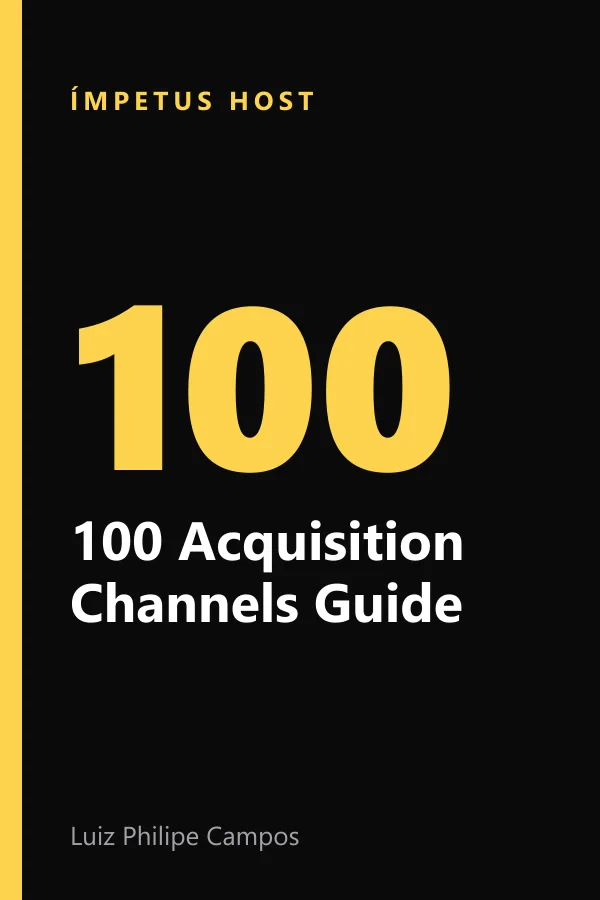
Next step
Don't depend on a single way to win customers
Everything in this article works better when new customers arrive every month. Most businesses depend on two or three channels and suffer when one of them slows down. The 100 Acquisition Channels Guide shows 100 ways to win customers, a practical example of each one and the first step to test it spending little or nothing.
- ✓The 100 channels, one by one, from the best known to the ones almost nobody uses
- ✓A practical example and a low-cost first step for each channel
- ✓A simple way to choose the channels that fit your business now
- ✓Bonus: Channel scorecard
- ✓Bonus: 30-day test plan
One-time payment · Instant access · 7-day guarantee
Access is immediate and the PDF arrives in your inbox. It costs less than a service call, it's a one-time payment and it has a 7-day guarantee through Hotmart.
You don't have to change professions or become a salesperson. You have to be on the right list when someone's phone rings at 7:40 a.m.
Tara, Ed and Leo are characters created for this text.Frequently asked questions
How do I get clients as a service provider?+
Start with partnerships with professionals who serve your client before or after you, such as architects for an electrician or accountants for a lawyer. Then keep a complete Google profile, ask for reviews at the moment the client feels the result and document stories of completed jobs. The goal is to have at least three channels bringing in clients.
How do I get more client referrals?+
Ask for the referral at the moment the client sees the value of the service, not at the quote or at payment. Give them something easy to share, like a summary of the work or a card. Swap referrals in a structured way with complementary professionals, so referrals stop depending on luck.
Is it worth using service platforms to get clients?+
They can be worth it as one channel among several, especially at the start. The risk is relying on them alone, because rules, competition and fees change without warning. Use the platform to earn reviews and experience and, in parallel, build channels of your own, like partnerships and your Google profile.
Where can I find a list of channels for getting service clients?+
The 100 Acquisition Channels Guide, by Luiz Philipe Campos, brings together 100 channels in 10 parts, each with an example, a first step and a cost to test. It includes a worksheet to choose your first three channels and a 30-day test plan. Access is immediate through Hotmart, with a 7-day guarantee.
Does it work for my type of business?+
Yes. The channels cover local businesses, service providers, online stores, B2B companies and professionals. The guide helps you pick the ones that fit your case.
How do I receive the guide?+
Right after payment, Hotmart sends the access to your email. You can read it on your phone, computer or print it.
What if I don't like it?+
You have a 7-day guarantee. If it isn't for you, ask for a refund through Hotmart within that period.
The 100 Acquisition Channels Guide
100 ways to win customers without depending on a single source of sales
Get the 100 acquisition channels guide for $49One-time payment · Instant access · 7-day guarantee