
How to Sell More in Your Online Store Without Depending on Ads
A candle maker supplies two online stores. The month one store's ad card was declined, only the other reordered. He explains why.

Luiz Philipe (LP)
Updated October 24, 2026

I've been making candles for nineteen years, in a workshop behind my house. I don't understand ads, algorithms, any of that. But I can read something few people know how to read: a reorder.
When a store sells, it calls me. When it stops selling, it stops calling. There's no more honest report than that.
My name is Lou. And for four years I had two online store customers who looked like twins.
The ending, up front
I'll tell you the ending first, because it's the part that matters. An online store sells without depending on ads when it has other channels that keep bringing in orders with the campaign switched off: an email list of past buyers, content that shows up on Google, affiliates who refer, a marketplace used as a storefront and customer referrals. Ads can stay, but as an accelerator, not as the store's only outlet.
An acquisition channel, in my factory vocabulary, is any path through which a buyer reaches the store. Ads are one. Email is another. A sample inside the box is too.
Now, how I figured this out just by looking at reorders, that's the good part.
Tim and Rebecca
The two started almost together, selling scented candles and home diffusers. Both bought the same scents from me, in the same quantities, with the same kraft box and the same jute ribbon. The photos on their sites were similar. So were the prices. If you showed me the two pages without the names, I couldn't have told you whose was whose.
Tim was fast. He answered messages in seconds, tested a new ad every week, knew by heart what each click cost. Rebecca was slower, spoke softly and was always asking me for strange things: a small sample to send along with each order, a printed card, a text about where the wax came from.
For four years, both of their reorders came in at the same pace. Until a Tuesday in March.
The Tuesday the phone rang
Tim called me at seven in the morning, which he never did.
"Lou, hold the reorder. The bank declined the ad card on Saturday, the campaign stopped and I only noticed yesterday. Three days without an order. Not one."He fixed the card that week, but the ad account took a while to get back to its old pace. It was eleven days of almost no sales. March's reorder, he canceled. April's, he cut in half.
That same month, Rebecca's reorder arrived on the usual day. I thought it was strange and asked whether she advertised too.
"I do," she said. "But if I turn it off tomorrow, the store doesn't stop."I didn't understand. So she explained.
What Rebecca had and Tim didn't
Rebecca's ad was one of the store's doors. Tim's was the only one. The difference lay in five things she had built slowly, almost without anyone noticing:
1. An email list of past buyers. Every order became a contact, with permission. Every two weeks she sent a short email: a new scent, a tip on where to use each candle, the month's batch. First step: turn on email capture at checkout and write a real welcome email, with no coupon up front. If you want to stay out of spam, read how to use email marketing without landing in spam.
2. Content that shows up on Google. She had written simple pages answering what people searched for: which scent to use in the bedroom, how to make a candle last longer, why the flame smokes. First step: write down the ten questions customers ask most in support and turn each into a page with a complete answer and the right product at the end.
3. Affiliates. Three interior designers and a therapist each had their own link and earned a share of every sale they referred. First step: invite five people who already talk to your customer and offer a clear commission per sale, with a trackable link.
4. A marketplace as a storefront. She sold only starter kits on the marketplace, and inside each package went a card with her own store's address. First step: choose a few entry-level products for the marketplace and use the package as an invitation to discover the rest, within the platform's rules. If you're wondering whether it's worth joining, there's a piece on selling on a marketplace as a small business.
5. Referrals. The small sample she kept asking me for went into the package with a note: "This one is for you to give to someone." On the back, a discount code for the friend and another for the person who referred. First step: include in the package something the customer can pass along, with a code that shows where the sale came from.
None of these doors was fast. None brought in, alone, the same volume the ads brought on a good day. But together, they kept the store on its feet when the ads dropped. Anyone with three channels working has predictability, which is knowing, more or less, how many orders will come next month. Anyone with one lives at the mood of the platform.
The declined-card test
I learned something from Tim and Rebecca, and you can run the test without turning anything off.
Take last month's orders and sort them by source. How many came from ads? How many from email, from Google search, from referrals, from affiliates, from customers who typed the store's address from memory?
Now ask the question Tim only asked after eleven days at a standstill: if the card were declined tomorrow, how much of this would keep coming in?
If the answer is "almost nothing," you don't have an online store. You have a campaign with a website behind it.
It's not a judgment, it's a diagnosis. And the remedy is the same for everyone: open a new channel, measure for thirty days, decide, open the next.
What happened next
Tim isn't dumb. In May, he called me again, this time to ask for Rebecca's phone number.
They talked for an hour. She gave him no formula. She just said she hadn't built the five doors all at once. She started with email, because she already had the contacts. Six months later, the affiliates. A year later, the content pages. "One door at a time, and measuring each one."
And she said something else, which he repeated to me later: the channels she used weren't the only ones out there. They were the ones that had worked for her. There were others she had never tested, like live-stream selling, a subscription program, a free tool, co-marketing with another brand. Each store had to find its own.
Today the two are back to reordering at the same pace. But only one of them sleeps easy when the bank sends a message on a Saturday.
Which side your store is on
There's one kind of store owner who measures success by the cost per click.
And there's another who measures it by what's left when the clicking stops.
Both work hard. Both know how to photograph a product and answer a customer. But one of them is building a store. The other is renting someone's attention every month.
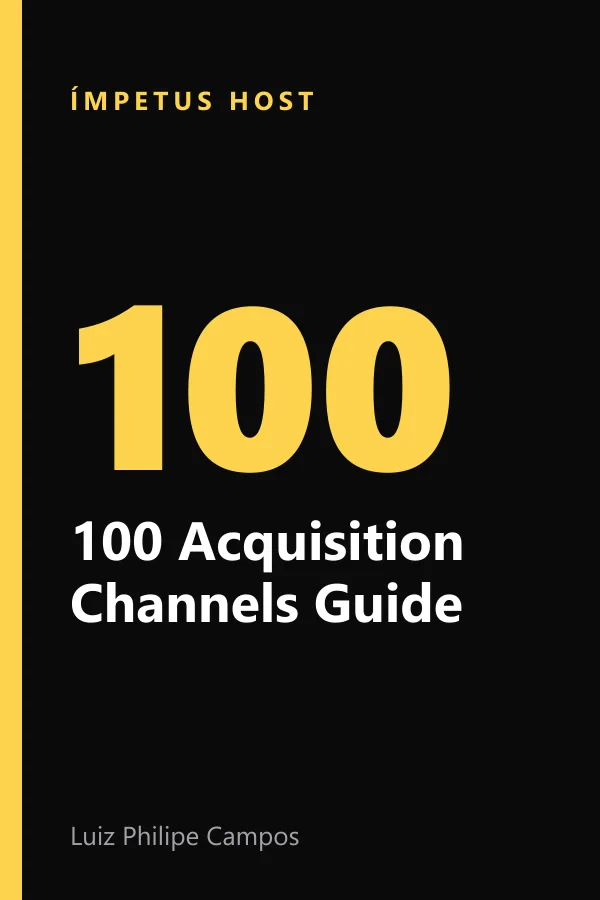
What Rebecca did over years, alone and by trial and error, can start with a map. The 100 Acquisition Channels Guide, by Luiz Philipe Campos, brings together 100 channels in 10 parts: referrals, partnerships and affiliates, content and search, social media and video, paid ads, prospecting, communities, platforms and marketplaces, offline and PR. For each channel: what it is, a practical example, the first step to test it, who it works best for and what it costs to test. Along with it, a worksheet to score the channels and choose your store's first three, and a 30-day plan, day by day, to launch the first and know whether to keep it, adjust it or swap it.
Next step
Don't depend on a single way to win customers
Everything in this article works better when new customers arrive every month. Most businesses depend on two or three channels and suffer when one of them slows down. The 100 Acquisition Channels Guide shows 100 ways to win customers, a practical example of each one and the first step to test it spending little or nothing.
- ✓The 100 channels, one by one, from the best known to the ones almost nobody uses
- ✓A practical example and a low-cost first step for each channel
- ✓A simple way to choose the channels that fit your business now
- ✓Bonus: Channel scorecard
- ✓Bonus: 30-day test plan
One-time payment · Instant access · 7-day guarantee
The PDF reaches your inbox right away. It costs less than a day of ads, and the first channel you test can be free, like the list of people who have already bought from you.
If it doesn't suit your store, Hotmart refunds the payment within 7 days. What doesn't come back are the days of a stalled store.
Lou, Tim and Rebecca are characters created for this text.Frequently asked questions
How do I sell in an online store without paid ads?+
The most accessible channels are email to past buyers, content that answers customers' questions on Google, an affiliate program, referrals with a discount code, a marketplace as a storefront and social media with video. The safest path is to open one channel at a time, measure for thirty days how many orders it brought in and only then move to the next.
Why do my sales drop when I stop advertising?+
Because ads are probably the store's only channel. When all of your incoming buyers depend on a single source, any problem with it, such as a declined card, a banned account or higher costs, shows up directly in revenue. Having other channels running reduces that impact.
Does email marketing work for a small online store?+
It does when the list is made up of people who bought or asked to receive your emails, sends are consistent and the content is useful, not just coupons. For a small store, it's one of the cheapest channels to test, because the contacts are already in your order history.
What's in The 100 Acquisition Channels Guide?+
It covers 100 customer acquisition channels in 10 parts, each with an explanation, an example, a first step, who it works best for and a cost to test. As bonuses, it includes a scoring worksheet to choose your first three channels and a 30-day test plan. Access is immediate through Hotmart, with a 7-day guarantee.
Does it work for my type of business?+
Yes. The channels cover local businesses, service providers, online stores, B2B companies and professionals. The guide helps you pick the ones that fit your case.
How do I receive the guide?+
Right after payment, Hotmart sends the access to your email. You can read it on your phone, computer or print it.
What if I don't like it?+
You have a 7-day guarantee. If it isn't for you, ask for a refund through Hotmart within that period.
The 100 Acquisition Channels Guide
100 ways to win customers without depending on a single source of sales
Get the 100 acquisition channels guide for $49One-time payment · Instant access · 7-day guarantee