
How to Sell More Without Lowering Your Price
Two coffee shops, the same downturn, the same supplier. One cut prices and emptied the till; the other changed where customers came from. What the supplier saw up close in both.

Luiz Philipe (LP)
Updated October 24, 2026

I've been delivering roasted coffee for fourteen years. Two-pound bags, cases of six, invoice stapled to the lid. Anyone in this line of work learns to read a business by the order it places.
An order that grows slowly and never fails is a healthy business. An order that takes a leap and then starts arriving with requests for longer terms is another story. I've seen that story many times. The clearest of them happened with two of my customers in the same town, Roger and Fiona, in the same half-year.
They had similar coffee shops, bought the same beans, charged practically the same for a cup. And both called me the same week in August, saying the same sentence: traffic is down.
What each did after that call, I followed through the order sheet. And it tells the story better than either of them would.
The short answer
To sell more without lowering your price, change where your customers come from, not the number on the tag. Channels like referrals, content that teaches and partnerships with trusted businesses bring in people who arrive already convinced of the value of what you sell. Discounts and coupons bring in people who compare pennies and leave at the competitor's next markdown. The channel picks the customer before you do.
What Roger did
Roger did what almost everyone does when traffic drops: he lowered the price.
First, a coffee-and-croissant promotion at lunchtime. Then, a coupon on a deals app. Then, a "buy one, get one free" on Tuesdays. By the third week, he called me thrilled. The place was packed.
In the fourth week, he asked to switch to a cheaper bean. Nobody will notice, he said. In the sixth week, he asked to pay in sixty days instead of thirty. In the eighth, he asked whether I could give him a discount too, because margins are tight.
The place was still packed. The till wasn't.
The problem wasn't traffic. It was who was coming in. Those who came for the coupon had come for the coupon. When the coupon ran out, they went looking for the next one, at the coffee shop down the block. And the old customers, who used to pay full price without complaint, began waiting for Tuesday.
The discount didn't bring new customers. It brought visitors. And it taught the old customers to pay less.
What Fiona did
Fiona made me a strange request in September. She wanted two pounds of a special lot, which she had never bought, and asked if I could come by on a Saturday morning to talk for ten minutes about the farm it came from.
It was a class. Twelve people sitting at the counter learning to brew coffee at home, with the shop's beans. On the way out, each took home a bag at full price, and a card with a line: bring someone next Saturday and your class coffee is on us.
In October, her order had a new line: cases for a law firm two blocks away. She had gone there to offer coffee for their conference room, with the coffee shop's brand on the cup. The lawyers started scheduling client meetings at the coffee shop itself.
In November, another new line: a neighborhood bookstore began selling a kit with a book and a bag of her coffee. The two promoted the kit for each other.
She never discounted. The price of a cup, in fact, went up a little at the end of the year.
And her order never took a leap. It rose, month after month, without a request for longer terms attached.
Why discounts attract exactly the wrong customer
There's a simple rule behind the difference between the two: an acquisition channel only counts if it brings the right customer, not just traffic. An acquisition channel is the path through which a new customer reaches you. And every path selects a type of person.
Someone who arrives by coupon arrived because it was cheap. Someone who arrives on a friend's referral arrived because someone they trust said it was worth it. Someone who arrives after a class arrived because they understood what they were buying. Those are three different customers, even if they drink the same coffee.
Lowering the price is trying to solve at the price tag a problem that lives in the channel. Sometimes it works for a few weeks. Almost always it leaves a bill: lower margin, customers who've learned to wait for a promotion and the same shortage of new customers once the promotion ends.
Five channels that bring in people who value what you sell
None of these depends on lowering prices. All can be tested with little or no money.
1. Referrals with a reward for both sides. The person who refers and the person who is referred both get something, preferably something of yours, not cash. First step: choose the moment when the customer is most satisfied (right after delivery, the compliment, the result) and ask there. There's a step-by-step in referral program: how to create one that really works.
2. Content that teaches. A class, a demonstration, a workshop, a short video showing how it's done. People who learn from you understand why your price is what it is. First step: schedule a 30-minute class for a few customers and see how many come back.
3. Partnerships with a trusted business. Another business already has the trust of the customer you want. First step: list three businesses that serve your audience at a different time of day and propose a package or a cross-referral for 30 days.
4. Customer stories. A real customer telling what changed with your product sells value better than any promotion. First step: ask two longtime customers for permission to tell their story.
5. A customer club or community. People who feel part of something don't trade you for a few cents. First step: invite your best customers to a gathering, a tasting or a group with news before everyone else.
And how do you know if it's working? Ask every new customer how they got to you and write it down. After 30 days, count which channels brought the customers who came back to buy again. That's the number that matters.
The last visit
In March, Roger asked me to pause deliveries for a while. The same week, Fiona closed a second office account and asked if I had the capacity to double her order.
They started out alike. Same beans, same town, same dip in traffic in August. The difference wasn't product or price. One tried to bring in more people by lowering the value of what he sold. The other opened new paths through which came people who valued what she sold.
There's the business owner who, when sales drop, asks how much can I take off the price?
And there's the one who asks where has nobody come from yet?
The first lives from promotion to promotion. The second slowly builds a business that can charge what it's worth.
If you're one step away from launching your next promotion, it's worth asking Fiona's question first. The problem is that almost nobody knows more than three or four paths.
The 100 Acquisition Channels Guide, by Luiz Philipe Campos, founder of Ímpetus Host, shows 100, in 10 parts: referrals and word of mouth, partnerships, content and search, communities and events, PR and product, and five more. Each channel comes with what it is, a practical example, the first step to test it, who it works best for and what it costs to test. You use the worksheet that comes with it to score the channels by cost, speed and fit and choose the three that make sense for your business, and you follow the 30-day plan to test the first before touching a penny of your price.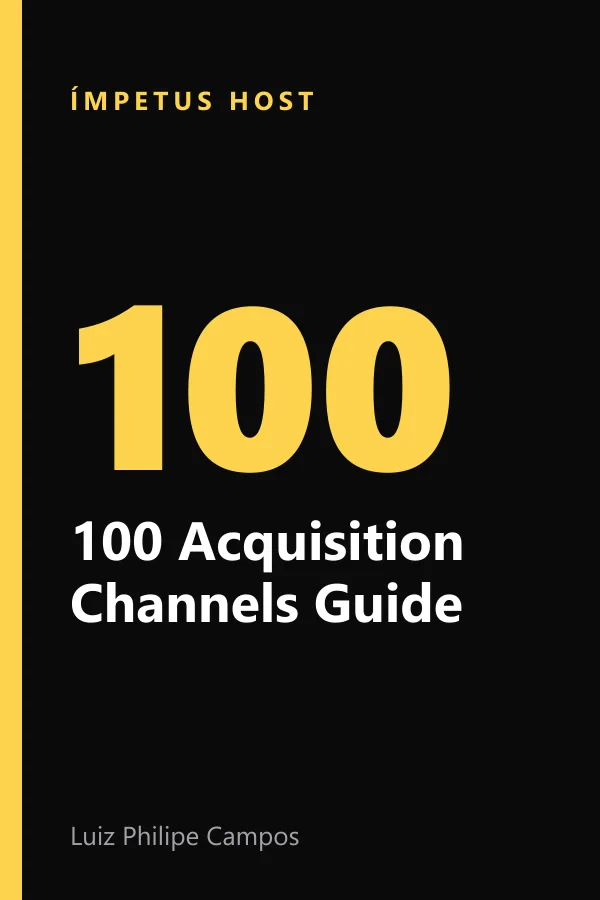
Next step
Don't depend on a single way to win customers
Everything in this article works better when new customers arrive every month. Most businesses depend on two or three channels and suffer when one of them slows down. The 100 Acquisition Channels Guide shows 100 ways to win customers, a practical example of each one and the first step to test it spending little or nothing.
- ✓The 100 channels, one by one, from the best known to the ones almost nobody uses
- ✓A practical example and a low-cost first step for each channel
- ✓A simple way to choose the channels that fit your business now
- ✓Bonus: Channel scorecard
- ✓Bonus: 30-day test plan
One-time payment · Instant access · 7-day guarantee
It's a PDF with immediate access, delivered to your inbox right after purchase. If it doesn't suit you, there's a 7-day guarantee through Hotmart to ask for your money back.
It costs less than a week of discounts in your window. And it doesn't teach anyone to wait for Tuesday.
Roger and Fiona are characters created for this text.Frequently asked questions
How do I sell more without offering discounts?+
Change the channel through which customers arrive. Referrals, content that teaches, partnerships with trusted businesses and customer stories bring in people who arrive already understanding the value of the product. Discounts tend to attract people who compare prices and leave at the next promotion.
Is giving discounts always bad?+
No, but discounts as your main way of attracting customers usually reduce your margin and teach existing customers to wait for promotions. When used, they work better with a clear goal and a set deadline, such as introducing a new product. The problem is using price to solve a shortage of acquisition channels.
How do I compete with a competitor who charges less?+
Don't try to beat them on price unless your costs are genuinely lower. Compete on trust and perceived value: show how your product is made, ask for referrals at the right moment and partner with businesses your customer already respects. People who arrive by those paths compare less.
Which acquisition channels attract customers who pay more?+
In general, trust-based channels: referrals, customer stories, educational content, partnerships and communities. The 100 Acquisition Channels Guide covers these and others, with the first step and cost to test each one, plus a worksheet to choose your first three.
Does it work for my type of business?+
Yes. The channels cover local businesses, service providers, online stores, B2B companies and professionals. The guide helps you pick the ones that fit your case.
How do I receive the guide?+
Right after payment, Hotmart sends the access to your email. You can read it on your phone, computer or print it.
What if I don't like it?+
You have a 7-day guarantee. If it isn't for you, ask for a refund through Hotmart within that period.
The 100 Acquisition Channels Guide
100 ways to win customers without depending on a single source of sales
Get the 100 acquisition channels guide for $49One-time payment · Instant access · 7-day guarantee