
Why Does My Competitor Sell More Than Me?
Oscar was sure his competitor sold more because she charged less. He spent a week investigating her store and came back with six clues. None of them was price.

Luiz Philipe (LP)
Updated October 24, 2026

For 22 years, Oscar had opened his paint store at seven-thirty. Three years earlier, Natalie had opened another one, two blocks away, in the same Tulsa neighborhood.
The first year, he thought it was funny. The second, he stopped finding it funny. The third, on a Tuesday in August, he counted the cars parked in front of her store at lunchtime — nine — and the ones in front of his — one, his own.
That night, he told his wife:
"She's selling below cost. There's no other explanation."Wednesday morning, he picked up a black-covered notebook, wrote "Natalie" on the first page and decided that, for one week, he was going to find out what she did.
Clue 1: The Price Was the Same
He sent his nephew to buy a gallon of white acrylic paint at both stores. Same brand, same finish.
Hers cost two dollars more.
Oscar wrote it in the notebook, underlined it twice and stared at the page for a while. The theory that had explained three years of decline lasted one morning.
Why a Competitor Sells More: The Short Answer
When two similar businesses sell very different amounts, the explanation is almost never the product or the price. Most of the time, the competitor is present in more of the places where customers decide to buy — they have more acquisition channels working, and most of them don't show up for someone who looks only at the storefront.
An acquisition channel is any path by which a new customer arrives: a Google search, someone's referral, a partner, a group, an event. Oscar had one: the door. He was about to find out how many Natalie had.
Clue 2: The Nephew's Phone
On Wednesday afternoon, he asked his nephew to search on his phone as if he were a customer: "paint store near me."
Natalie's store came up first, with hundreds of reviews, photos of walls painted by customers, correct hours and a reply to every comment, even the bad ones. His came up third, with eleven reviews, a photo of the storefront from years ago and the wrong Saturday hours.
"Uncle Oscar, nobody goes to your place because Google says you close at noon."He hadn't closed at noon in six years.
Clue 3: Saturday, Eight in the Morning
On Saturday, Oscar drove slowly past her store and saw an easel on the sidewalk: "Free workshop: paint your wall without streaks. Saturday, 8 a.m."
He parked at the corner and watched. Fourteen people inside, most of them women, listening to a painter explain how to thin the paint and use the roller. At nine-thirty, they came out. Almost all of them carrying a bag.
Nobody there had been looking for a paint store that morning. They'd come to learn. And they bought from whoever taught them.
Clue 4: The Painters' Board
On Monday, he walked into Natalie's store for the first time. He pretended to look for sandpaper.
Near the register there was a cork board with cards from painters, electricians and drywallers in the neighborhood, each with a name, a phone number and a hand-drawn star. He overheard the conversation at the counter:
"Do you know a good painter?" "I know several. This one painted the yellow house on the street above."The painter got referrals. And when the customer asked the painter where to buy materials, the painter sent them to the store that recommended him. One hand washing the other, every day, with no ads.
Clue 5: The Property Manager
On Tuesday, an acquaintance who managed an apartment building downtown mentioned, knowing nothing, that he had received "a really well-prepared quote" for painting the building's exterior. From Natalie's store. She visited property management companies and sent quotes by email, with the quantity calculated and the suggested painter.
A building exterior sells more paint than a month at the counter.
Clue 6: The Bag
On Wednesday, a week after he began, Oscar asked a neighbor to show him the bag from her last purchase there. Inside, along with the receipt, was a card with a QR code: "Calculate how many gallons you need." A free calculator, on the phone. Anyone who used it left their contact and, days later, got a message: "Did the painting go well? Need anything else?"
What the Notebook Said on the Last Page
On Friday, a longtime customer walked into Oscar's store to buy a brush. Just a brush. Oscar asked, point-blank, where he had bought the paint for his home renovation.
"At the young lady's. The painter sent me."The painter was an old acquaintance. He had bought from Oscar's store for fifteen years, until the day someone began referring him.
Oscar wrote the last sentence in the notebook: "She's not better than I am. She's in more places."
How to Find Out Your Competitor's Channels
You don't need a week or a black notebook. You need to look through a customer's eyes, in every place where they decide:
Search like a customer. Google your service with "near me" and with the neighborhood name. Compare reviews, photos, hours and replies. Ask an AI assistant, too, which is the best option in your city and see who it cites.
Ask the people who arrived. Ask every new customer — yours and, when you can, the other's — how they found the company. The answer reveals the channel.
Map who refers. Professionals, suppliers and neighboring businesses that serve the same audience. Find out who they send people to.
Look at their calendar. Events, workshops, trade shows, neighborhood team sponsorships, participation in a business association.
Open the bag. Packaging, receipt, card, QR code, a message after the purchase. What happens after the sale is often the channel that brings the next one.
Talk to suppliers. They sell to both of you and know who is growing and how.
Once you've done that, pick one of the clues that fits your business and test it for 30 days. One at a time. Oscar started with the cheapest: fixing his Google profile and asking every counter customer for a review. We cover how to do it without awkwardness in how to get more Google reviews.
You're on the Side of Those Who Look at the Storefront
There's the business owner who watches a competitor grow and explains it with what's in plain view: price, location, luck, "she has a partner with money." And there's the one who goes to find what isn't in plain view.
The first spends years cutting margin to compete on a price that was never the problem. The second discovers the fight was never over the customer walking down the street, but over all the roads that lead to the street.
Oscar found six channels in a week of spying. And he came away with a question that applies to any business: how many others exist that neither she nor I use?
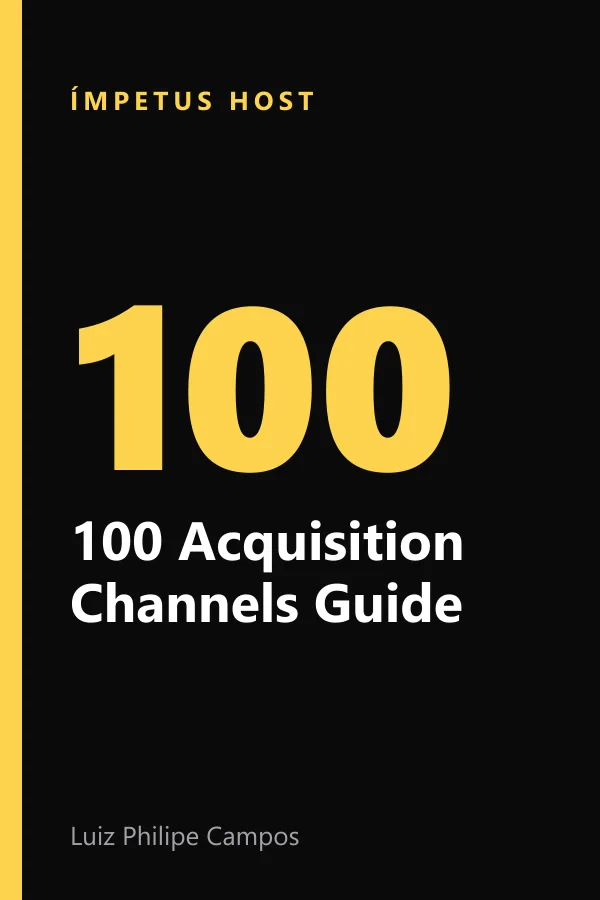
The 100 Acquisition Channels Guide answers that question. 100 channels, in 10 parts — from referrals and partnerships to Google search, communities, events, platforms, offline and press — and each one comes with what it is, a practical example, the first step to test it, who it works best for and what it costs to experiment. Reading it, you'll recognize the channels your competitor uses without you seeing — and you'll find some he hasn't discovered yet. The bonus spreadsheet helps you choose the three that fit your business best, and the 30-day plan shows how to launch the first.Instead of a week investigating your neighbor, an afternoon reading the whole map.
Next step
Don't depend on a single way to win customers
Everything in this article works better when new customers arrive every month. Most businesses depend on two or three channels and suffer when one of them slows down. The 100 Acquisition Channels Guide shows 100 ways to win customers, a practical example of each one and the first step to test it spending little or nothing.
- ✓The 100 channels, one by one, from the best known to the ones almost nobody uses
- ✓A practical example and a low-cost first step for each channel
- ✓A simple way to choose the channels that fit your business now
- ✓Bonus: Channel scorecard
- ✓Bonus: 30-day test plan
One-time payment · Instant access · 7-day guarantee
Access is immediate, as a PDF, and Hotmart guarantees seven days. It costs less than a gallon of good paint.
Your competitor doesn't have a secret. They have doors you haven't opened yet.
Oscar and Natalie are characters created for this text.Frequently asked questions
Why does my competitor sell more if the product is the same?+
In most cases, because they're in more of the places where customers decide to buy: they show up better on Google, get referrals from partners, run events, take part in groups or stay in touch after the sale. Those channels almost never show up for someone who looks only at the store or the price.
How do I find out where my competitor's customers come from?+
Search for your service as if you were a customer, compare Google profiles and reviews, watch their events and partnerships and ask new customers how they found each company. Suppliers and professionals who serve the same audience also tend to know who is growing and how.
Does lowering my price help when my competitor sells more?+
Only when price is truly the reason, and often it isn't. Lowering prices without knowing the cause shrinks your margin and doesn't bring in the customers who are reaching your competitor by another path. First, find out which channels they use and test one of them for 30 days.
Where can I find sales channels my competitor doesn't use?+
The 100 Acquisition Channels Guide gathers 100 channels in 10 parts, each with an example, a first step, who it works best for and a cost to test. With the bonus spreadsheet you choose three channels, and with the 30-day plan you test the first one. Access is immediate and there's a seven-day guarantee through Hotmart.
Does it work for my type of business?+
Yes. The channels cover local businesses, service providers, online stores, B2B companies and professionals. The guide helps you pick the ones that fit your case.
How do I receive the guide?+
Right after payment, Hotmart sends the access to your email. You can read it on your phone, computer or print it.
What if I don't like it?+
You have a 7-day guarantee. If it isn't for you, ask for a refund through Hotmart within that period.
The 100 Acquisition Channels Guide
100 ways to win customers without depending on a single source of sales
Get the 100 acquisition channels guide for $49One-time payment · Instant access · 7-day guarantee