
What Makes One Business Sell More Than Another?
Two pet shops on the same sidewalk, same dog food, same price sheet. One started ordering double; the other blamed the street. The guy who delivers to both saw the difference before they did.

Luiz Philipe (LP)
Updated October 24, 2026

For eleven years I've driven the truck for a pet food distributor. Every Tuesday, at seven in the morning, my first stop is the same street: two pet shops, one on each side of the sidewalk, separated by a pharmacy.
You can learn a lot about a company just by looking at its order.
For three years, the two ordered almost the same. Forty bags, sometimes forty-five. Same brand, same price sheet, because the price sheet is mine. Owen, on the left side, had the nicest store on the street. Renee, on the right, had a wooden counter that was begging for a refit.
In March last year, Renee's order went up to sixty. In August, ninety. In December I had to come back on Thursday, because Tuesday couldn't handle it.
Owen's order stayed at forty. Some months, thirty-two.
It wasn't the product. It was the same bag, coming off the same truck, unloaded by the same helper. Something had changed on the right side of the sidewalk, and it took me almost a year to figure out what.
The Short Answer
What makes one business sell more than another is almost never the product or the price. It's the number of paths through which the right customer reaches it. A business that depends on one channel sells only what that channel lets in; a business with three acquisition channels working knows where the next customer is coming from.
An acquisition channel is any path that brings a new customer to the business: a referral, a Google search, a partnership with another business, an ad, a trade show. Most small businesses have one. The ones that grow have three or four, and know how to measure each.
What I Saw on the Right Side
On a rainy Tuesday, Renee offered me coffee while my helper stacked the bags. I asked, half joking, whether she'd won the lottery.
She laughed and showed me three things.
The first was clipped to the register: a pad of cards. "Refer a friend: on their first visit, you both get a free groom." She said the card had existed for years. What changed was when she handed it out. "Before, I left it on the counter and nobody picked it up. Now I hand it over when the owner comes to pick up the dog from the groom and says it looks wonderful. That's when the person is happy with me."
The second was on her phone. The store's Google profile, with a new photo every week, correct hours and every review answered by name. People who moved into the neighborhood and searched for a pet shop near home found Renee first. Owen had a profile too. His nephew had set it up four years earlier, with the old phone number.
The third was the one that made me forget the coffee. On the wall, a fridge magnet from the vet clinic a block down. "The vet sends people to us for food and grooming. We send them to her for shots and checkups. Every week someone comes from there with her little slip of paper in hand."
Three channels. None expensive. None magic. And none of them depended on someone walking past on the sidewalk.
What I Saw on the Left Side
Crossing the street is the shortest stretch of my route. On the other side, Owen was complaining about foot traffic, like almost every Tuesday.
"The street is dead. These days everybody buys everything online."The street was the same. The pharmacy in the middle was full. And his neighbor had just taken delivery of ninety bags.
Owen wasn't a worse shopkeeper. He opened early, served customers well, kept the store spotless. All of that matters. But he had a single source of customers, the door, and the door depended on the luck of the day. When the luck was weak, he had no other place to look.
One sold to people who walked by on the sidewalk. The other also sold to people who didn't even know the sidewalk existed.
Renee's Three Channels, and How to Start Each One
What Renee did fits any neighborhood business and plenty of companies that don't even have a store. The detail almost nobody copies is that she didn't start all three at once. She started with the cards in March, counted how many came back each month and only then moved on to Google. The partnership came last.
1. Structured referrals. A spontaneous referral is luck; a structured referral is a process. First step: pick the moment when the customer is happiest (the delivery, the compliment, the problem solved) and offer an advantage to both sides, the referrer and the person referred. How to measure: count how many cards or codes come back each month.
2. Google business profile. It's the channel for people already searching for what you sell, right now, near you. First step: check your phone number, hours and address today; then ask your last satisfied customers for a review and answer every one. How to measure: ask every new customer how they found the store.
3. Partnership with a complementary business. Other companies already serve the customer you want, before or after you do. First step: list three businesses that sell to the same audience without competing with you and propose cross-referrals, with simple material for each side to hand out. How to measure: the little slip with the partner's name, or the question "who referred you?"
Notice that all three answer the same question: is the right customer already there? The dog owners were at the clinic, on Google and in conversations with friends. She just opened a door in each place.
If you want to see the full map of possible paths, this piece explains what acquisition channels are and which ones exist.
The Day Owen Crossed the Street
In November, Owen caught me on the running board of the truck. He looked across the street and asked, point-blank, what she did that he didn't.
I told him the three things.
He stood quiet for a while and then laughed, a little embarrassed: "That's it?"
That's it. And every week, without stopping in the months when the store was busy.
By the following Tuesday, he had fixed up his Google profile. But right there he asked me the question I couldn't answer: "And after that, what else can I do? She found three. There must be others."
There are. And that's the question where most business owners get stuck.
Which Side of the Sidewalk Are You On
Almost every business owner knows by heart which product is their best. Very few can say, without thinking, where their last ten customers came from. If the answer is just one, referrals, the street, Instagram, a single ad, you're on the left side of the sidewalk. You can be the best shopkeeper on the street and still live in feast or famine.
Owen discovered three paths because he looked at his neighbor. You don't have to wait for a neighbor to succeed to know they exist.
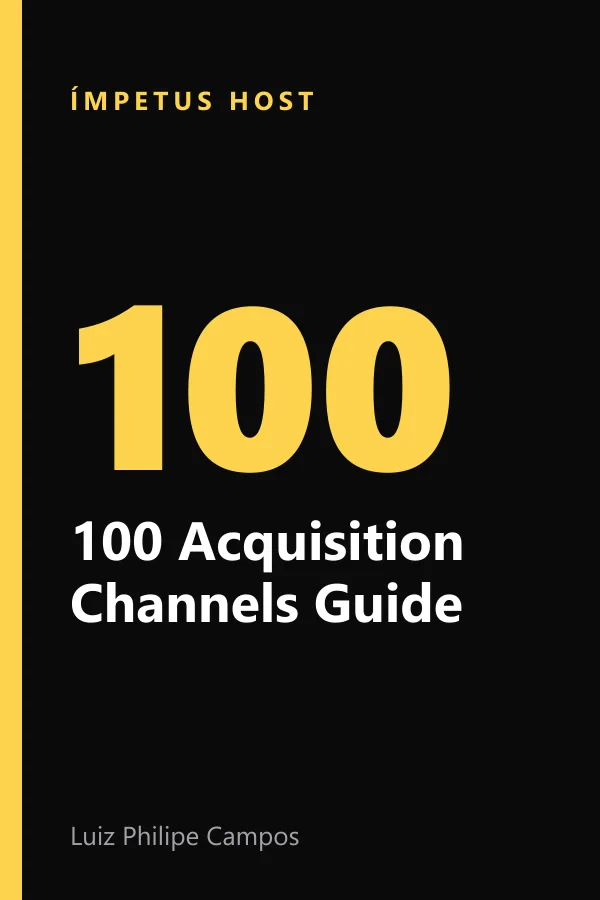
The 100 Acquisition Channels Guide gathers, in 10 parts, a hundred paths to bring in customers: referrals, partnerships, search and content, social media, ads, active prospecting, communities and events, marketplaces, local actions and press. For each channel, it shows what it is, a practical example, the first step to test it, who it works best for and what it costs to try, from free to high. It comes with a spreadsheet to score channels on cost, speed and fit and choose your first three, and a 30-day, day-by-day plan to get the first one up and decide whether to keep it, adjust it or swap it.It's the answer I didn't have on the running board of the truck.
Next step
Don't depend on a single way to win customers
Everything in this article works better when new customers arrive every month. Most businesses depend on two or three channels and suffer when one of them slows down. The 100 Acquisition Channels Guide shows 100 ways to win customers, a practical example of each one and the first step to test it spending little or nothing.
- ✓The 100 channels, one by one, from the best known to the ones almost nobody uses
- ✓A practical example and a low-cost first step for each channel
- ✓A simple way to choose the channels that fit your business now
- ✓Bonus: Channel scorecard
- ✓Bonus: 30-day test plan
One-time payment · Instant access · 7-day guarantee
It's a PDF that lands in your inbox right after purchase, to read on your phone or print and leave on the counter. It costs less than one day of an empty store, and it has a 7-day guarantee through Hotmart: if it doesn't work, you ask for your money back.
And you don't need to open a hundred channels. The guide itself says: start with one, measure for 30 days, then add the next. That's exactly what Renee did, one card at a time.
Owen and Renee are characters created for this text.Frequently asked questions
Why does one business sell more than another with the same product?+
In most cases, because it has more paths bringing in customers. One depends on a single channel, like foot traffic or spontaneous referrals, while the other combines two or three measured channels, like structured referrals, a Google profile and partnerships. The product can be identical; what changes is how many of the right people reach it.
How many acquisition channels does a small business need?+
Three channels working already give most small businesses predictability. The important thing is not to open them all at once: start with one, test it consistently for 30 days, measure how many customers it brought and only then add the next.
What's the cheapest acquisition channel to start with?+
Usually the ones that use relationships you already have: structured referrals, a Google business profile and partnerships with complementary businesses. All three can be tested at zero or very low cost. What they require is routine, not budget.
What's inside The 100 Acquisition Channels Guide?+
100 customer acquisition channels in 10 parts, each with what it is, a practical example, the first step to test it, who it works best for and what it costs to try. It includes four rules for choosing channels, a scoring spreadsheet to pick your first three and a day-by-day 30-day test plan. Access is immediate through Hotmart, with a 7-day guarantee.
Does it work for my type of business?+
Yes. The channels cover local businesses, service providers, online stores, B2B companies and professionals. The guide helps you pick the ones that fit your case.
How do I receive the guide?+
Right after payment, Hotmart sends the access to your email. You can read it on your phone, computer or print it.
What if I don't like it?+
You have a 7-day guarantee. If it isn't for you, ask for a refund through Hotmart within that period.
The 100 Acquisition Channels Guide
100 ways to win customers without depending on a single source of sales
Get the 100 acquisition channels guide for $49One-time payment · Instant access · 7-day guarantee